October 26, 2026
An independent hearing panel has found that Tuolumne County’s waste enforcement agency failed to act.
Ruling on a petition brought by nine neighbors, the County’s Local Enforcement Agency Independent Hearing Panel found that state law required an immediate cease and desist order at 18955 Industry Way, that the enforcement agency issued none, and that in the Panel’s words there were “no orders; i.e., no real enforcement action.” The decision is unanimous. What it says →
What the Panel decided
On September 15, 2026, nine neighbors petitioned the County’s Local Enforcement Agency Independent Hearing Panel under Public Resources Code section 44307, which lets any person be heard on an enforcement agency’s failure to act. The Panel heard the matter on October 15 and issued its written decision on October 26, 2026. All three members signed it.
It found:
Public Resources Code section 44002(b) and title 14, section 18304.3(a) required an immediate cease and desist order. The enforcement agency issued none. There were “no orders; i.e., no real enforcement action.”
Finding 5
Alongside that, the Panel found that the agency had determined by May 14, 2025 that the Site was an unpermitted disposal site, and that its letters and spoken directives since “are not orders” and were ineffective (Finding 3). That sampling had been called for on five occasions and that “as of October 15, the hearing date, no LEA sample was collected” (Finding 2). That the Site should have been designated a closed, illegal or abandoned disposal site, which would have fixed an inspection schedule, and that there was “no evidence of inspection reports made through SWIS” (Finding 1). That the crushed concrete the agency had slated for testing “has been removed” and no action was taken (Finding 16). And on the question that has shadowed this site for five years — whether what was buried here is harmless inert debris —
“There is no evidence to support the [inert] classification.”
Finding 15
The Panel ordered the agency to enforce its own May 11, 2026 directive, to inspect and complete sampling, to inform the petitioners, to take enforcement action resulting in “preservation of site materials for testing, abatement, and corrective actions,” and to escalate “up to and including cease and desist orders.”
No order carries a deadline, and the Panel did not retain jurisdiction to check compliance. Whether the agency now acts, and how quickly, is left to the agency.
The decision is not final. Either side may appeal to CalRecycle until November 5, 2026. This page will be updated as developments occur.
Documents behind this section
- Decision and Order of the Local Enforcement Agency Independent Hearing Panel October 26, 2026 — the full decision, with all signature pages
- Petition for hearing under Public Resources Code § 44307 September 15, 2026
- Response of the Local Enforcement Agency, with exhibits September 30, 2026
What is next door
Since at least 2021, an industrial waste operation has run at 18955 Industry Way, within feet of people’s homes — crushing, grinding, stockpiling, and filling an ephemeral creek with debris of unknown origin and undetermined content. It has never held a solid waste facility permit.
That is not a characterization. It is what the County’s own enforcement agency wrote:
“Currently the fill is considered by the local LEA as an Unpermitted Inert Debris Solid Waste Disposal Site.”
Tuolumne County Local Enforcement Agency letter, May 14, 2025
Though the Panel found, in October 2026, no evidence supporting the conclusion that the debris is inert.
“the Slaton property with the ‘Unpermitted Solid Waste Disposal Site’ (fill) located on the property … This is a contentious operation near residences.”
Debra Larson, LEA Director, to CalRecycle, January 15, 2025
In the state’s Solid Waste Information System (“SWIS”), the site’s regulatory status is Unpermitted. California law does not treat that as paperwork: Public Resources Code section 44000.5 bars disposing of solid waste anywhere but a permitted facility, and says that “[a] violation of this section is an unlawful act.” Why this page says “illegal” →
Documents behind this section
- LEA determination letter May 14, 2025
- LEA Director and CalRecycle January 15, 2025
- Solid Waste Information System record, facility 55-AA-0017 — Summary Captured October 10, 2026 — regulatory status “Unpermitted”
- Same record — Inspection documents Captured October 10, 2026
- Same record — Enforcement documents Captured October 10, 2026
- Why this page says “illegal” The statute, CalRecycle’s classification of this site, and the argument against it
What the County’s own laboratory found in 2022
The air district’s notes of a January 13, 2022 meeting with Community Development and Public Works record that serpentine rock from Sierra Rock Products was applied at the site on December 21, 2021; that the district took two grab samples averaging 1.87% asbestos against the 0.25% threshold at which the surfacing rule applies; and, in its own words:
“We knew he was over that and was subject to the rule.”
Tuolumne County Air Pollution Control District, meeting notes, January 13, 2022
Laboratory analysis of material from the site, Report No. 220111004 dated January 11, 2022, reported chrysotile and tremolite asbestos at 1.50% and 2.25%.
California law does not treat this material casually. Where serpentine or ultramafic aggregate is sold or supplied for anything other than surfacing, title 17, section 93106(d)(3) of the California Code of Regulations requires the seller to hand the buyer a written receipt carrying this statement, word for word:
“WARNING!
Cal. Code Regs., tit. 17, § 93106(d)(3)
This material may contain asbestos.
It is unlawful to use this material for surfacing or any application in which it would remain exposed and subject to possible disturbances.
Extreme care should be taken when handling this material to minimize the generation of dust.”
Section 93106(c) goes further: no person may use, sell or supply such material for surfacing “unless it has been tested using an approved asbestos bulk test method and determined to have an asbestos content that is less than 0.25 percent.”
So far as the plaintiffs are aware, no asbestos dust mitigation plan was required, and the operation was not halted.
Three weeks after the testing, the County’s own air district wrote internally that the operator “hasn’t been as truthful the last couple months as we would have liked,” that serpentine covered “almost the entire property,” and that his dust-suppression claim “is not a factual statement.” The Chief Building Official replied that there were “no violations.”
Airborne asbestos is not the only concern. Serpentinite carries chromium, nickel and cobalt, which can move into water — and a Drainage Protection Area recorded on the 1973 parcel map runs through this site and down into Sullivan Creek.
Documents behind this section
- Air Pollution Control District meeting notes January 13, 2022 — the December 21, 2021 application and the 1.87% sampling result
- Sierra Rock Products warning receipts, signed on delivery Obtained from the Air Pollution Control District
- Sierra Rock Products weighmaster certificate Blank form — shows the warning as pre-printed on the certificate
- Laboratory Report No. 220111004 January 11, 2022 — 1.50% and 2.25% chrysotile and tremolite
- Air Pollution Control District internal email February 11, 2022
- Parcel map, 1973 Records the Drainage Protection Area crossing the site
The County issues two permits, neither of them the right kind
The County issued a grading permit to the operator in 2019, ostensibly to construct a driveway to an existing building pad. The permit allowed for grading of up to 450 cubic yards on what the County’s own Notice of Exemption describes as a 2.49± acre parcel. There was no existing building pad. There is none today.
On June 13, 2022, Public Works determined that the permit “was issued in error, and is therefore null and void,” and on July 27, 2022 the County served a Notice of Grading Permit Revocation on the owners of record. The notice records that “[t]he original grading permit application of 2019 identified 450 cubic yards,” and states that “[a]s per the Director of Community Development, no activities currently undertaken on the parcel constitute a specific development project.”
Six months later, the operator asked the County for help figuring out how to get “the right permit”:
“it’s been awhile since I emailed you back about meeting to get the right permit to fill this hole on our commercial property … You guys stopped us in the middle of working on the project.”
Bruce Slaton to the County, January 26, 2023
The hole is the drainage protection area. Five days later: “Thank you for helping us try to resolve this issue , hopefully this idea with a single family home will resolve the matter.” Three weeks after that: “any word on the single family home plan for the site?”
The County’s Environmental Coordinator told the operator the project was exempt from site development permit review as a ministerial permit — a permit the County has no discretion to deny, and one that carries the right to grade. In 2023 the operator applied for and received a permit to install a 586 square foot manufactured home, sited, on the plat map filed with the application, in the drainage protection area. The permit was extended twice. No building was ever started, and the permit has since expired. There is no home on the site.
The permit the site required but never received was for a waste disposal site. As the Panel found, it was the County’s job to ensure compliance with solid waste regulations, and it failed to fulfill its responsibility. No local grading permit or building permit on its own could allow the operator to circumvent state level health and safety law.
The plot plan referral form the County circulated for that building permit, dated June 29, 2023, leaves three boxes unchecked: “Do Not Issue – Asbestos Dust Mitigation Plan Required (> One Acre),” “Attach Asbestos Airborne Toxic Control Measures (≤ One Acre),” and “Send Copy of Permit to the Air Pollution Control Office” — the office that had taken the 2021 samples. The parcel is 2.49 acres. A note attached to the form reads “Expedite per Quincy.”
The form is posted below. Read it and draw your own conclusions; we are not going to tell you what anyone was thinking.
Documents behind this section
- Notice of Exemption, grading permit G2019-00027 “an existing commercial building pad” — 450± cubic yards on a 2.49± acre parcel
- Notice of Grading Permit Revocation, Case E22-004 July 27, 2022 — the permit “was issued in error, and is therefore null and void”
- Emails between the operator and the County January and February 2023 — “the right permit to fill this hole” and the single-family-home proposal
- Plot plan referral form, permit B2023-01196 June 29, 2023 — the “Expedite per Quincy” note
Five years of letters, and no orders
On March 19, 2024, County Code Compliance issued a Notice and Opportunity to Correct with a May 22 deadline, warning that a Notice and Order with penalties would follow. No correction ensued. No Notice and Order was ever issued. Three months after that deadline passed, over three consecutive nights in August 2024, County Public Works deposited Tuolumne Road surface material at the same site. The neighbors were not notified.
In September 2026, CalRecycle produced its correspondence with the County in response to a public records request. What it shows is a state agency telling a county agency what to do, and a county agency not doing it:
- July 24, 2024 — CalRecycle sends the County a model cease-and-desist order, issued by Merced County’s enforcement agency in a case where an owner had likewise refused to allow sampling.
- November 21, 2024 — CalRecycle’s Closed, Illegal, and Abandoned Sites unit recommends a letter telling the owner the site “would be considered a Close [sic] Illegal Disposal Site,” subject to periodic inspections. No such letter appears in the record.
- May 2025 — CalRecycle: “the fill must cease and be closed in place.”
- July 3, 2025 — CalRecycle’s internal timeline: “ultimately, it is the LEA’s responsibility to follow through with their actions.”
- July 18, 2025 — the LEA Director, reporting that the operator was working the face of the fill: “I asked him to stop and he said he will comply.”
- September 12, 2025 — the agency tells CalRecycle its oversight “has been extensive,” describes the material as “similar to a concrete foundation,” and proposes recording a Notice of Action against the property so that any future buyer would learn of the fill. The plaintiffs checked with the County Recorder in August 2026. No Notice of Action was ever recorded.
- May 29, 2026 — the LEA Director writes to CalRecycle that Mr. Slaton told her he had used crushed concrete to “backfill” a trench project, and that he “has the contract with the Camage Road Waste Management Facility that takes in Inert Debris Type A from the public.” Because “the source of the inert debris is unknown,” she writes, he “is unable to use it for his work, backfill a trench, use it for a private driveway, or use it for private road base, sell it for fill, etc.” She adds that the agency “will be conducting lab testing” of the ground asphalt.
- June 9, 2026 — CalRecycle replies that “[t]he LEA needs to determine” whether the material is “indeed Inert debris (non-hazardous),” and that if the asphalt contains serpentine or asbestos, its use “should be referred to the local Air Control District.” The Panel found in October 2026 that as of the hearing no agency sample had been collected.
This is the sequence the Panel described, in October 2026, as letters and spoken directives that “are not orders.”
Documents behind this section
- Notice and Opportunity to Correct March 19, 2024 — County Code Compliance
- Merced County cease-and-desist order May 22, 2024 — the model CalRecycle sent the County
- CalRecycle to the County November 21, 2024 — both emails
- CalRecycle internal timeline July 3, 2025
- LEA Director to CalRecycle July 18, 2025
- LEA letter to CalRecycle, complete three pages September 12, 2025 — including the page proposing the Notice of Action
- LEA Director and CalRecycle May 29 and June 9, 2026 — the trench backfill, the Camage contract, and what CalRecycle told the County to determine
- The full document index Everything posted on this site, by source and date
Water
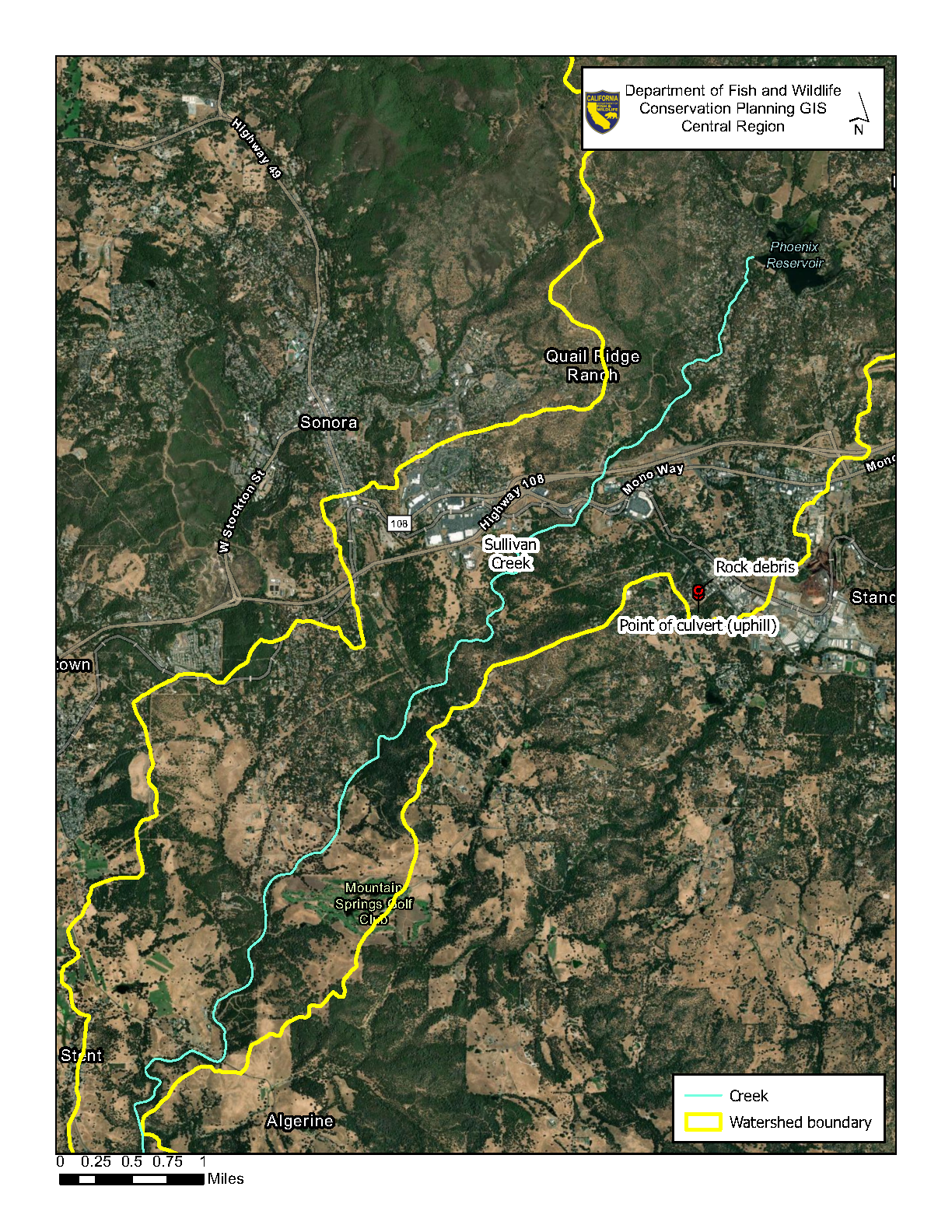
Serpentine gravel sits on this site alongside an undetermined — but, the plaintiffs believe, substantial — quantity of chunk and crushed concrete, in and adjacent to a drainage protection area that leads to Sullivan Creek. That combination is potentially a serious problem. Concrete debris raises the pH of water, and hexavalent chromium becomes more mobile, not less, as water turns alkaline. California’s drinking water standard for hexavalent chromium is 0.010 milligrams per liter, in effect since October 1, 2024.
A watershed map produced by the California Department of Fish and Wildlife shows the relationship between the site and the creek, with the property marked by a red pin: Sullivan Creek watershed map →
What is actually happening in the water here is unknown, because apart from the January 2022 asbestos testing, no testing has been done by the County or by any state agency. The plaintiffs have asked the County to bring in the Regional Water Quality Control Board to sample under conditions likely to produce leachate, and to test for pH and heavy metals, including hexavalent chromium. They are still waiting.
Documents behind this section
- Sullivan Creek watershed map California Department of Fish and Wildlife — the property is the red pin
- Parcel map, 1973 Records the Drainage Protection Area crossing the site
2026: what was to be tested is gone
On May 11, 2026, the enforcement agency directed that material be removed under dust control, with a removal plan, a destination, and receipts — and that the crushed serpentinite be sampled for asbestos before any disposal, with chain of custody and split samples offered. A separate pile of crushed concrete was to be tested for crystalline silica. That pile was removed later the same month, untested, with no removal plan, no disclosed destination and no receipts.
Then, beginning September 4, 2026 — a month after this lawsuit was filed — more material left the site with no effective oversight by the County.
- Equipment was mobilized on September 3. A plaintiff called the Sheriff.
- Removal began the morning of September 4. The LEA Director, the Director of Community Development, and an officer of the Air Pollution Control District were present and did not stop it. One of them told a plaintiff there was “nothing they could do.”
- A member of this office asked, on site, for a sample. The operator’s representative refused.
- Removal resumed on September 8, and material was removed again on September 16.
- It was hauled to Sierra Rock Products, Inc., in Jamestown. On September 10, its president told this office that about 90% had already been processed and mixed into resale inventory.
No asbestos test preceded the removal. The only analysis of the removed material was commissioned by Sierra Rock — the company that received it — with samples collected by its own president after most of it had been processed. Two grab samples of “black asphalt,” analyzed by visual estimation, no chain of custody, no split sample, no independent consultant.
In its filing of September 30, 2026, the enforcement agency stated that the officials’ presence “reflects agency supervision of a removal the LEA had itself requested.” What that supervision consisted of, beyond watching the operator disregard the agency’s own May 11 directives, the filing does not say.
The operator refused to allow the enforcement agency access to perform the testing directed in the May 11, 2026 letter. The agency reported to CalRecycle that it was looking into getting a warrant. No warrant was ever sought. No testing was done.
Documents behind this section
- LEA removal and testing directive May 11, 2026 — with site photographs of April 30, 2026
- Enforcement demand to the LEA June 2, 2026 — the County confirms it received this; nothing in the record answers it
- Response of the Local Enforcement Agency September 30, 2026 — including the laboratory report commissioned by the recipient
What the operator says
Bruce Slaton has twice put his position in writing — in a verified opposition filed in the Superior Court on September 16, 2026, and in a response to the neighbors’ petition served on October 14, 2026. Both are posted below. His words are on the left. The documents answering them are on the right.
“the only evidence before this Panel is that the material that was removed from the site around September 11, 2026 was tested off-site, by Precision Micro-Analysis, Inc., an independent testing agency, the very day the material was received (9/11/2026), and found to have NO ASBESTOS.”
Response to the § 44307 Petition, October 14, 2026
That testing was commissioned by Sierra Rock Products, the company that had received the material, and the samples were collected by its own president after about 90% of it had been processed and mixed into inventory. The laboratory may be independent; the sampling was not. It was not done under the protocol the County had directed on May 11, 2026. The Panel found that as of October 15, 2026 the enforcement agency had collected no sample of its own.
“essentially harmless road-base, found all over Tuolumne County”
Verified Opposition, September 16, 2026
The County’s own laboratory report of January 11, 2022 reports chrysotile and tremolite asbestos at 1.50% and 2.25% in serpentine rock at the site. The regulatory threshold is 0.25%. The agency’s May 11, 2026 letter says the material “may pose a respirable asbestos concern.”
The operation is “NOT a fly-by-night, under the radar operation,” and the work was done “with applicable permits and entitlements.”
Verified Opposition, September 16, 2026
The grading permit was revoked on July 27, 2022. The site has never held a solid waste facility permit; its state regulatory status is “Unpermitted.” The County’s own agency determined on May 14, 2025 that it is an unpermitted solid waste disposal site, and the Panel found on October 26, 2026 that there is “no evidence to support” classifying the material as inert debris.
Material “has been stored on and removed from the Subject Property in the ordinary course of business for years.”
Verified Opposition, September 16, 2026
Public Resources Code section 44000.5 prohibits disposing of solid waste anywhere but a permitted facility and provides that “[a] violation of this section is an unlawful act.” Section 44002(a)(1): “No person shall operate a solid waste facility without a solid waste facilities permit.”
He is “NOT an owner of the Subject Property,” though he “has assisted in the development” of it and has “personal knowledge” of it.
Verified Opposition, September 16, 2026
A grant deed recorded June 22, 2020 conveyed the property to the Woodworth trust as to 50% and to John Lamar Slaton as to 50%, as tenants in common. The Contractors State License Board lists BJ Slaton Trucking as Bruce Slaton’s sole proprietorship.
Documents behind this section
- Verified Opposition of Bruce Slaton to the application for a temporary restraining order Filed September 16, 2026
- Response of Bruce Slaton to the § 44307 Petition October 14, 2026
Where this stands
The civil case. Anderson, et al. v. Slaton, et al., No. CV68663, Tuolumne County Superior Court, filed August 3, 2026 by eight plaintiffs from five households. An answer was filed for defendant Bruce Slaton on October 1, 2026. An amended complaint adding three more plaintiffs is in preparation.
The restraining order. On September 17, 2026 the court signed a temporary restraining order concerning the removal and preservation of material. It never took effect. The court conditioned it on the filing of a $10,000 undertaking, which was not filed, and the order expired by its own terms on September 23, 2026.
The Panel decision. Issued October 26, 2026. Either side may appeal to CalRecycle until November 5, 2026. The plaintiffs have asked the County what the enforcement agency will now do, and when.
What this page does not say
This page makes no claim that anyone has been diagnosed with an asbestos-related illness. The plaintiffs’ claims concern exposure risk, damage to their property and water, and the loss of the use and quiet enjoyment of their homes. It does not assert where any particular load of material originated beyond what the posted records show, and it does not assert that material at this site came from any business not named in those records.
The documents
Each section above links the records behind it. The complete index is here — every document posted on this site, grouped by source and dated. All were obtained from public agencies, from public records requests, or from the files of the court and the hearing panel.
About this page. This page is maintained by counsel for the plaintiffs in Anderson, et al. v. Slaton, et al. It sets out the plaintiffs’ allegations and the public records those allegations rest on. Allegations are not findings, and no court has ruled on the merits of the civil case. Where this page draws a conclusion from a document, it says so, and the document is linked so you can read it and reach your own. The defendants, the County, and the Local Enforcement Agency are invited to respond, and we will post any response they send us. If you believe anything here is inaccurate, write to Renee@ReneeOrth.com.